


A djellaba is a long, loose Moroccan robe with a traditional hood. It reaches the ankle, it is cut full so it hangs away from the body, and the hood is attached rather than detachable. If it has no hood, it is not a djellaba.
You will see it written djelleba, djellaba and jellaba. All three are the same garment. Which one you use says more about where you learned the word than about the robe.
Why one garment has three spellings
The word is Arabic, and Arabic is not written in the Latin alphabet. Putting it into English letters has always been guesswork, and different people have guessed differently.
- Djellaba comes through French writing in North Africa and is the most common spelling in dictionaries.
- Jellaba drops the silent d and is common in English writing.
- Djelleba is closest to how the word sounds in Moroccan Arabic, and it is what many Moroccan families abroad write.
Something worth knowing if you have been second guessing yourself: looking at what people actually type into Google before they reach our store, djelleba is by far the most common spelling, roughly twenty-eight times more common than djellaba. Neither is wrong.
You will also see jalabiya, jalabiyya, galabeya and galabiyya. Those are the Egyptian and Gulf names for a long men’s robe, and they are a different garment: usually cut straighter, plainer at the neck, and with no hood. Closer to a Moroccan gandoura than to a djellaba.
The hood is the whole point
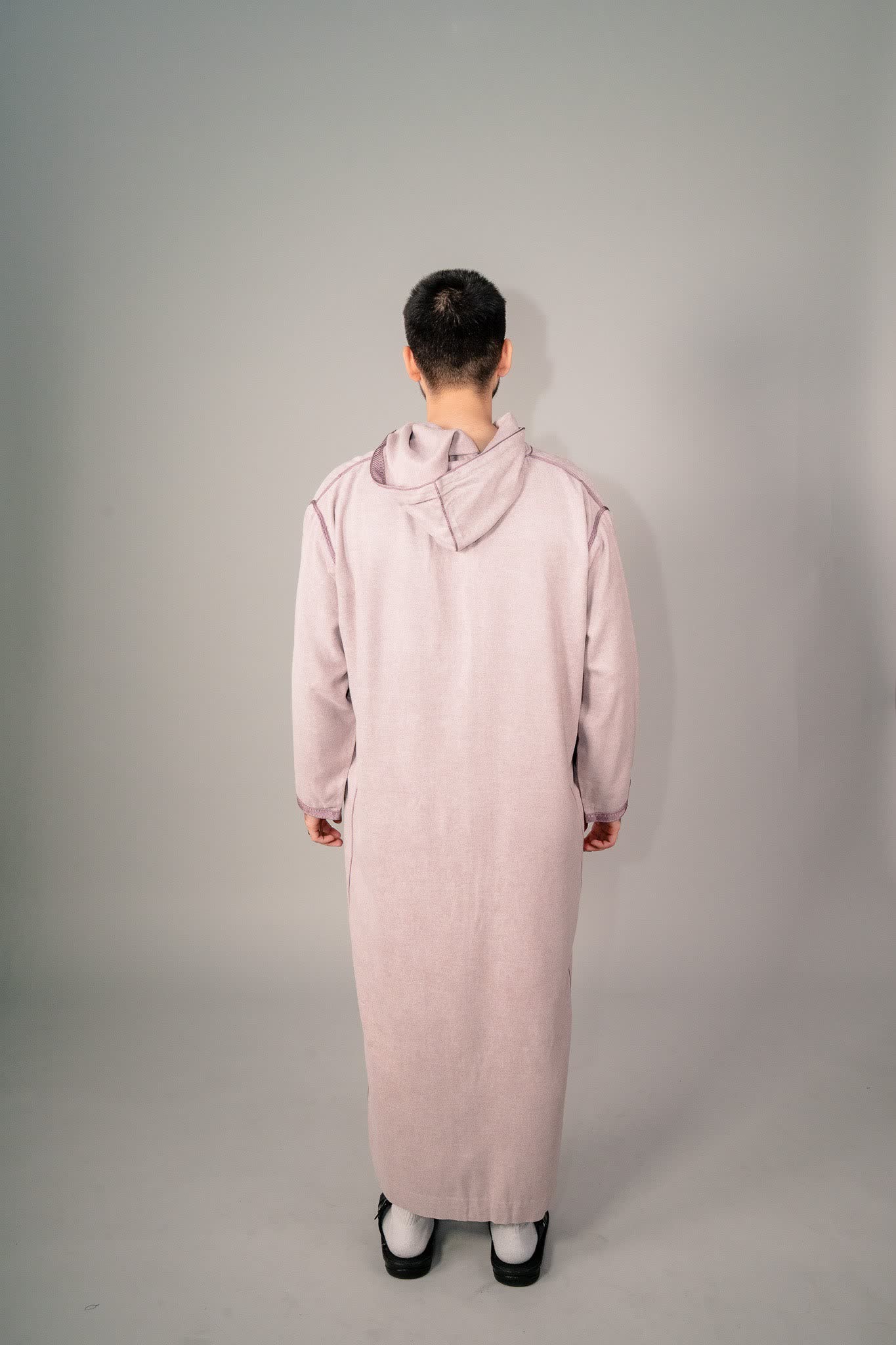
The hood is called a qob, and it is the feature that defines the garment. A proper one is traditional, attached, and large enough to actually pull up over your head and still see out.
It has always been practical rather than decorative. Morocco gets fierce sun, cold mountain nights and wind carrying dust, and a hood you can raise deals with all three without carrying anything extra.
This is the easiest thing to check before buying and the most common thing sellers get wrong. Plenty of robes are listed as djellabas with a small decorative hood that will not go over your head. Look for a photo with the hood up. If there isn't one, assume there is a reason.
Winter and summer djellabas are different garments
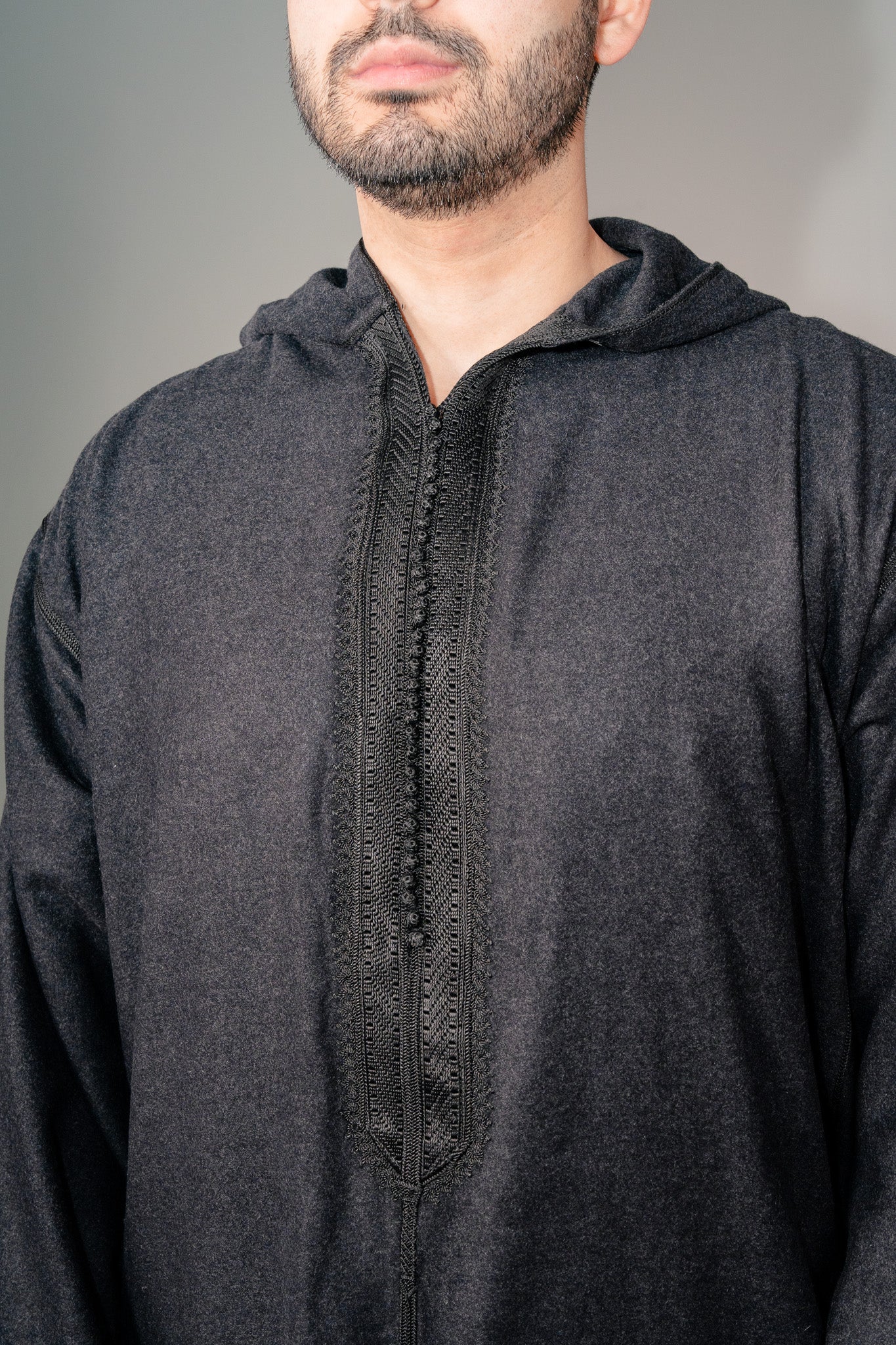
Both are hooded and both are called djellaba, and that is where the similarity ends.
A summer djellaba is cut from thin cloth, often cotton, and worn on its own in heat.
A winter djellaba is heavyweight, cut fuller, and made to go over whatever you are already wearing. It is closer in purpose to a coat than to a robe. Ours are cotton, polyester and viscose, woven with enough weight to hold their shape as you walk.
If you buy one expecting the other you will be disappointed, so check the fabric weight before ordering rather than going by the photo.
The detail almost everyone gets wrong
A traditional winter djellaba has no pockets. Instead there are two open slits at the sides.
This reads as a fault until you understand what the garment is for. Because the djellaba goes over your other clothes, the slits let you reach through to your trouser pockets. Adding pockets to the djellaba itself would mean carrying your keys in the outer layer you take off first.
It is worth knowing before you buy rather than after.
Djellaba, kaftan or thobe?
Thobe is the umbrella word for a long men's robe. Djellaba and kaftan are two specific Moroccan versions of one.
| Djellaba | Kaftan | Gandoura | |
|---|---|---|---|
| Hood | Yes, traditional | No | No |
| Sleeves | Long | Long | Three-quarter |
| Neck | Button loops | Mandarin collar, zip | V neck, buttons |
| Weight | Heavy | Medium | Light |
| Worn | Over other clothes | On its own | On its own |
The simplest rule: a hood means djellaba, a mandarin collar means kaftan, three-quarter sleeves mean gandoura.
How to wear one
Over a kaftan or a gandoura, not instead of one. Size for what goes underneath, not for your body, because a djellaba worn over a kaftan needs room through the chest that the same size would not need on its own.
The hood sits down flat most of the time. Pulling it up is for weather, not for effect.
Ours are here: winter djellebas, hooded, sizes S to 2XL including an M/L. If you want the detail on fabric weight and layering, read best winter djellebas.